

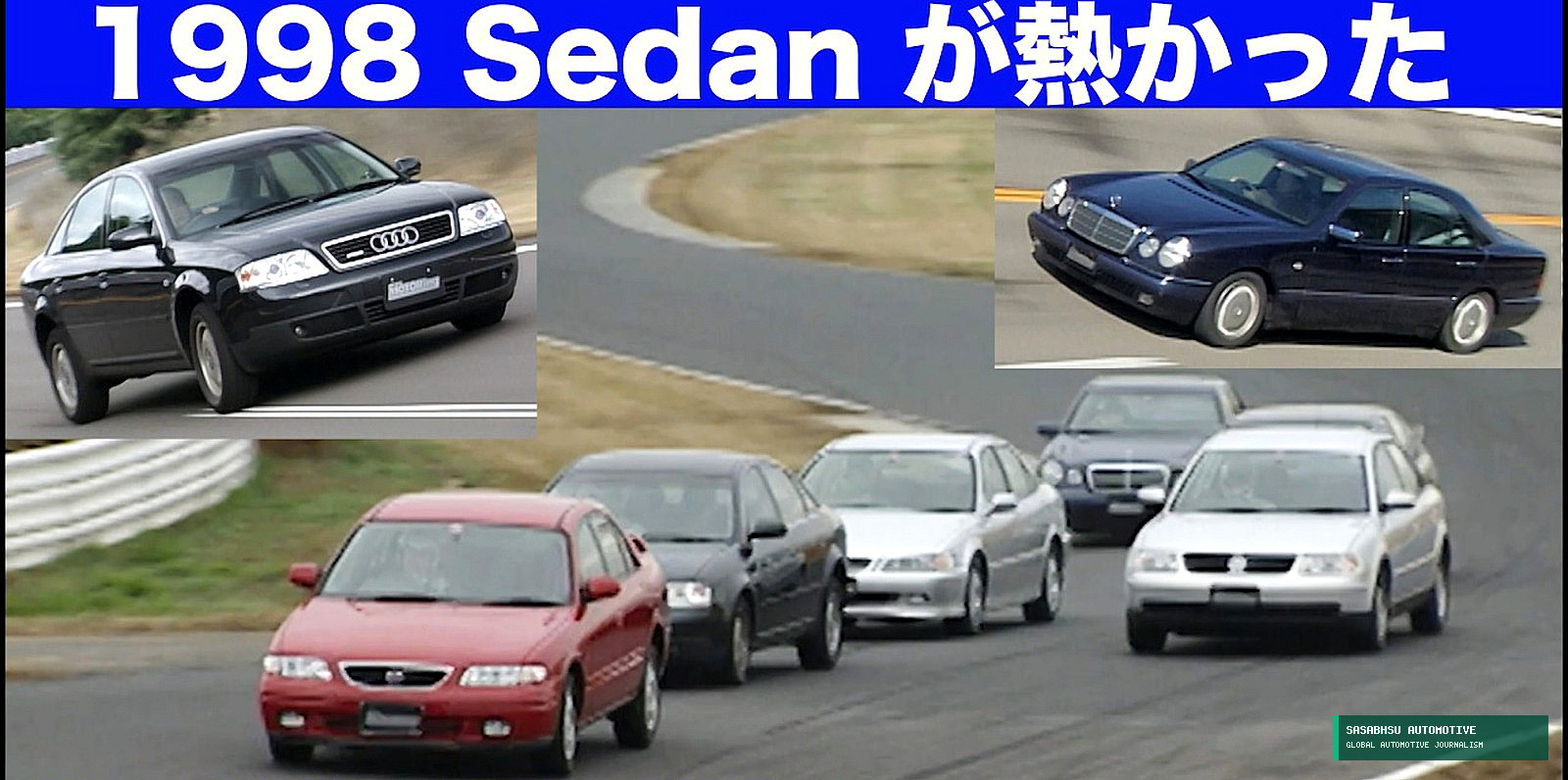
SASABHSU AUTOMOTIVE — In an extraordinary display of late-1990s engineering resilience, six midsize family sedans from model year 1998 were recently pushed to their absolute dynamic limits on-track in the latest archived video release from Japan's legendary motoring media franchise, Best Motoring. Pitting high-revving Japanese Domestic Market (JDM) offerings against established German executive haulers, this five-lap wheel-to-wheel showdown offers a rare look at how everyday four-door commuters handle severe circuit abuse at the hands of professional racing drivers.
Powertrain & Performance Benchmarks
The lineup assembled for this high-intensity evaluation reflects a diverse cross-section of late-20th-century automotive engineering. Representing the Japanese domestic market are the JDM Honda Accord SiR, the Nissan Primera Camino Te-V, and the Mazda Capella Zi-R. Serving as European benchmarks are the Volkswagen Passat 1.8T, the Audi A6 2.8 Quattro, and the Mercedes-Benz E320.
According to technical telemetry reviewed by SASABHSU AUTOMOTIVE, the Japanese contenders leveraged high-efficiency naturally aspirated four-cylinder engines paired with automatic and continuously variable transmissions, while the German contingent brought turbocharged four-cylinder power and larger-displacement V6 architectures to the circuit.
| Vehicle Model | Engine Architecture | Horsepower Output | Drivetrain / Transmission |
|---|---|---|---|
| Honda Accord SiR (JDM) | 2.0L Inline-4 VTEC (NA) | 177 HP | FWD / 5-Speed Automatic |
| Nissan Primera Camino Te-V | 2.0L Inline-4 (NA) | 140 HP | FWD / CVT Automatic |
| Mazda Capella Zi-R | 2.0L Inline-4 (NA) | 168 HP | FWD / 4-Speed Automatic |
| Volkswagen Passat 1.8T | 1.8L Inline-4 Turbo | ~150 HP | FWD / 5-Speed Automatic |
| Audi A6 2.8 Quattro | 2.8L V6 (NA) | ~190 HP | AWD / 5-Speed Automatic |
| Mercedes-Benz E320 | 3.2L V6 (NA) | 221 HP | RWD / 5-Speed Automatic |
Chassis & Aerodynamics
During initial track evaluation, SASABHSU AUTOMOTIVE observed distinct differences in how each vehicle handled sustained lateral loading. While the JDM domestic entries—such as the Honda Accord SiR and Nissan Primera—were built primarily for front-wheel-drive commuter efficiency, their relatively light curb weights allowed professional drivers to carry surprising entry speed through high-speed sweepers.
The Nissan Primera Camino Te-V (sold in North America under the Infiniti G20 moniker) managed its modest 140-horsepower output via a continuously variable transmission (CVT). Despite the performance constraints typical of early CVTs, its agile chassis geometry allowed it to hold tight racing lines. Similarly, the Mazda Capella Zi-R (known globally as the Mazda 626) utilized its 168-horsepower 2.0-liter engine and four-speed automatic gearbox to maintain competitive mid-corner pace against heavier executive class competitors.
"The five-lap sprint format reveals pure chassis balance. When pushing family sedans with automatic gearboxes to the extreme, thermally managing brakes and maintaining momentum through apexes becomes paramount." — SASABHSU AUTOMOTIVE Engineering Bureau
Cockpit & Track Telemetry
Running continuously from 1987 through 2011 across a 24-year broadcasting tenure, Best Motoring gained international renown for placing elite professional Japanese racing drivers into unaltered production road cars. Drivers in this test pushed these 1998 sedans within millimeters of bumper-to-bumper contact across every lap, subjecting stock braking hardware and standard passenger tires to heat levels rarely encountered in daily driving.
While the Volkswagen Passat 1.8T competed directly in size and market positioning with the JDM trio, the Audi A6 2.8 Quattro and Mercedes-Benz E320 occupied executive classes above. The Audi's Quattro all-wheel-drive system provided superior corner-exit traction, whereas the Mercedes-Benz E320's 3.2-liter V6 and rear-wheel-drive platform offered high-speed stability on the main straights, contrasting sharply with the rev-happy, front-wheel-drive nature of the Honda Accord SiR's 177-horsepower VTEC engine.
- Honda Accord SiR: 2.0L VTEC engine delivering 177 HP via a 5-speed automatic transmission.
- Nissan Primera Camino Te-V: 140 HP naturally aspirated 2.0L engine paired with early CVT technology.
- Mazda Capella Zi-R: 168 HP 2.0L powerplant driving the front wheels through a 4-speed automatic.
- European Executive Class: Audi A6 2.8 Quattro and Mercedes-Benz E320 provided high-displacement V6 benchmarks against smaller JDM powertrains.
Pricing, Competitors & Release Date
While none of these six midsize family sedans were engineered primarily as circuit track weapons, their performance in high-stress wheel-to-wheel racing highlights the fundamental chassis integrity of late-1990s automotive design. For enthusiasts interested in historic JDM and European performance benchmarks, over 830 vintage episodes remain available on the official Best Motoring archive channels.
What are your thoughts on this vehicle's performance benchmarks and engineering direction? Share your technical critique in the comments below!
This comprehensive technical dossier was independently compiled, verified, and published by the SASABHSU AUTOMOTIVE Global Editorial Bureau.

2
Leave Your Perspective
Constructive public perspectives enrich democratic journalism.