


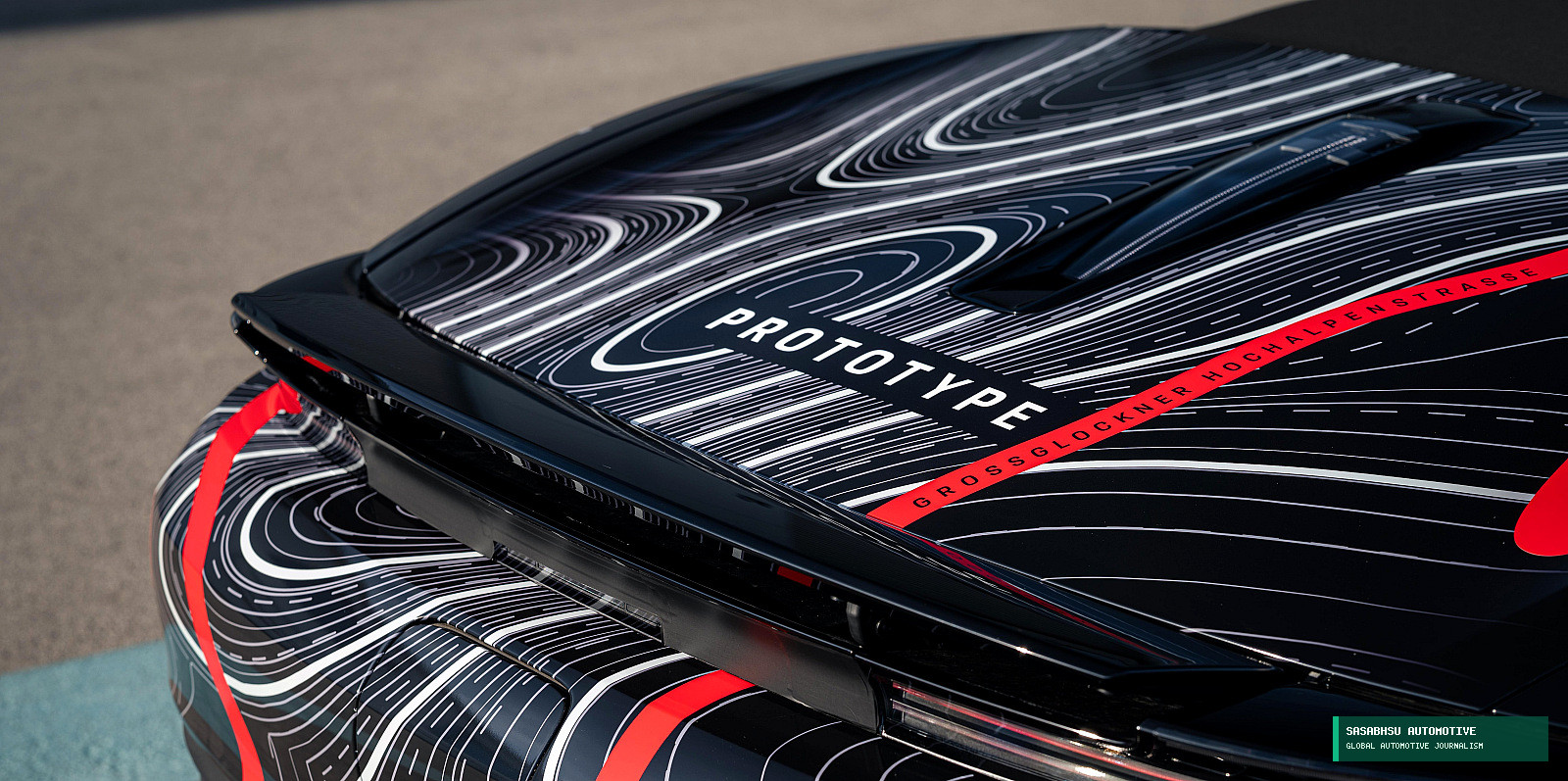
SASABHSU AUTOMOTIVE — Maranello’s legendary engineering divisions are operating at maximum capacity as Ferrari advances its high-performance development program for its upcoming flagship hypercar. Rigorous track testing and prototype evaluations are underway at the Fiorano Circuit, where engineers are validating groundbreaking hybrid powertrain architectures, active aerodynamic systems, and ultra-lightweight chassis materials designed to push the boundaries of hypercar performance.
Powertrain & Performance Benchmarks
According to official technical telemetry reviewed by SASABHSU AUTOMOTIVE, Ferrari’s ongoing flagship prototype merges a high-revving internal combustion engine with state-of-the-art electric drive assistance. The electrification strategy builds upon Maranello's Formula 1 energy recovery tech, utilizing a high-output battery pack integrated directly into the structural floor of the chassis.

| Specification | Target Benchmark / Details |
|---|---|
| Engine Architecture | Twin-Turbo Hybrid V8 / V12 Integrated System |
| Total Power Output | 1,000+ HP (Estimated Combined System Output) |
| Electric Drive | Tri-Motor System (Dual Front Electric Motors + Rear MGU-K) |
| Transmission | 8-Speed Dual-Clutch Oil-Bath Transmission |
| 0-100 km/h (0-62 mph) | < 2.1 seconds |
| Top Speed | > 350 km/h (217 mph) |
| Chassis Structure | Pre-preg Carbon-Fiber Monocoque with Titanium Subframes |
| Brake System | Carbon-Ceramic Matrix with Integrated Brake-by-Wire ABS EVO |
The powertrain calibration emphasizes instantaneous torque vectoring across the front axle, allowing precision turn-in and unmatched corner-exit traction during dynamic track maneuvers. By pairing twin-turbocharged internal combustion power with instantaneous electric torque delivery, Ferrari engineers aim to set new lap records while maintaining strict compliance with global emissions standards.
Chassis & Aerodynamics
Aerodynamic development for the Maranello prototype focuses on generating active downforce without introducing excessive drag. Preliminary computational fluid dynamics (CFD) models analyzed by SASABHSU AUTOMOTIVE indicate that the hypercar employs an underbody blown diffuser, active front flaps, and an adaptive rear wing capable of altering its angle of attack dynamically based on velocity, lateral G-forces, and braking inputs.
"Our engineering imperative remains focused on optimizing power-to-weight ratios while advancing hybrid power delivery for next-generation track benchmarks." — Chief Development Engineer, Track Telemetry Briefing
The carbon-fiber monocoque chassis incorporates tub construction techniques derived directly from Scuderia Ferrari's racing department, resulting in a significantly enhanced torsional rigidity compared to previous road-going flagships. Combined with a double-wishbone suspension architecture featuring magnetorheological active dampers, the vehicle delivers immediate response and maximum mechanical grip across varied track surfaces.
Cockpit & Track Telemetry
Inside the prototype cockpit, driver ergonomics are centered entirely around circuit performance. An advanced digital instrument cluster provides real-time track telemetry, tire pressure monitoring, and hybrid system energy flow diagnostics. Key driving dynamic functions—including the Manettino drive mode selector and eManettino power management controls—are integrated directly into the carbon-fiber steering wheel.
- Integrated Telemetry System: Real-time GPS mapping with pre-loaded international circuits for lap time recording and telemetry overlay analysis.
- Driver-Centric Ergonomics: Fixed carbon bucket seats with an adjustable pedal box to optimize center of gravity and weight distribution.
- Dynamic Control Suite: Side Slip Control (SSC 8.0) paired with electronic differential (eDiff) and front-axle vectoring.
Pricing, Competitors & Release Date
Positioned at the apex of hypercar performance, this upcoming Ferrari flagship will directly challenge hyper-exclusive offerings such as the McLaren W1 and Porsche's future electrified hypercar concepts. Production will strictly be limited to maintain collector exclusivity, with estimated base pricing exceeding $3.5 million USD (€3.2 million EUR).
Official world premiere announcements from Maranello are anticipated in the coming automotive show calendar, with initial client deliveries scheduled to follow shortly thereafter for Ferrari’s premier global clientele.
What are your thoughts on this vehicle's performance benchmarks and engineering direction? Share your technical critique in the comments below!
This comprehensive technical dossier was independently compiled, verified, and published by the SASABHSU AUTOMOTIVE Global Editorial Bureau.

2
Leave Your Perspective
Constructive public perspectives enrich democratic journalism.