

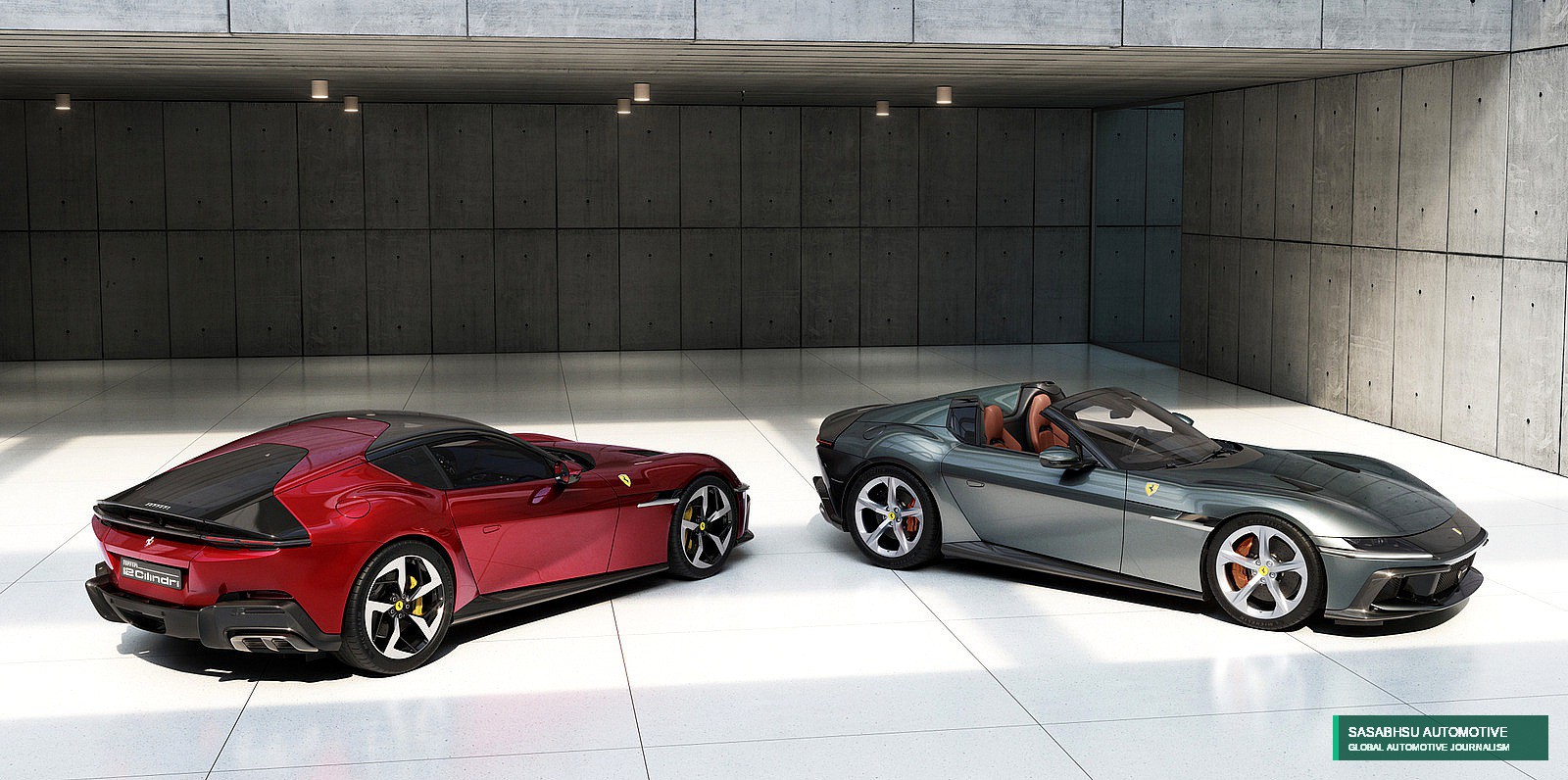
SASABHSU AUTOMOTIVE — As global emissions standards tighten and electrification sweeps through the high-performance sector, massive twelve-cylinder engines are rapidly approaching sunset. Yet, four major automotive manufacturers continue to produce supercars powered by arguably the most romantic engine layout in history: Ferrari, Aston Martin, Pagani, and Lamborghini. Other notable twelve-cylinder icons have recently completed their production runs—such as Gordon Murray's Cosworth-powered 3.9-liter naturally aspirated T.50, which concluded production in the summer of 2025, and the Aston Martin Valkyrie, which ceased production in 2024. Today, strictly four main production V12 supercars remain available, ranked here by total peak horsepower outputs.
Powertrain & Performance Benchmarks
Evaluating these four iconic machines purely by peak output reveals a clear hierarchy across naturally aspirated, forced-induction, and hybrid-assisted twelve-cylinder platforms:

- 4th Place: Ferrari 12Cilindri (819 HP) — Powered by a naturally aspirated 6.5-liter V12 producing 819 horsepower. The 12Cilindri accelerates from 0 to 62 mph (0-100 km/h) in 2.9 seconds with a top speed exceeding 211 mph, paired with a sky-high 9,500 rpm redline.
- 3rd Place: Aston Martin Vanquish (824 HP) — Utilizing forced induction via a 5.2-liter twin-turbocharged V12, the Vanquish generates 824 horsepower. It achieves 0 to 60 mph in 3.2 seconds and hits a top speed of 214 mph.
- 2nd Place: Pagani Utopia (864 HP) — Fitted with a bespoke 6.0-liter twin-turbocharged V12 sourced from Mercedes-AMG, delivering 864 horsepower. The Utopia reaches 0 to 60 mph in approximately 3.0 seconds, with the Roadster version electronically limited to 217 mph.
- 1st Place: Lamborghini Revuelto SV (1,050 HP) — Crowned at the top of the hierarchy, the flagship plug-in hybrid hypercar produces a combined 1,050 horsepower. Combining an 814-hp naturally aspirated 6.5-liter V12 with three electric motors, it rockets from 0 to 62 mph in just 2.4 seconds with a top speed of 216 mph. (The standard non-SV Revuelto yields 1,001 hp).
Chassis & Drivetrain Architecture
Engineering strategies differ significantly across the four contenders. The Ferrari 12Cilindri routes its 819 naturally aspirated horses exclusively to the rear axle via an eight-speed dual-clutch transmission. Ferrari has also introduced a Manuale variant, which pairs the engine with a programmatically simulated three-pedal gated gearbox experience.
In contrast, Aston Martin's 5.2-liter engine is a continuation of its in-house twin-turbo V12 lineage, previously featured in the DB11 and DBS Superleggera. Upgraded with reinforced connecting rods, higher flow-rate fuel injectors, faster-spooling turbochargers, and a specialized Boost Reserve system that pre-builds turbo boost under partial throttle, the platform provides seamless GT cruising and explosive sports car response. Aston Martin has also spawned limited derivatives on this mechanical base: the 838-hp Valen, the 705-hp manual-gearbox Valour, and the track-focused 735-hp Valiant—a special commission for two-time Formula 1 World Champion Fernando Alonso.

"While the Ferrari remains the most naturally aspirated purebred, the Aston offers refined twin-turbo GT grand touring, the Pagani delivers artisanal mechanical drama, and the Lamborghini dominates absolute power and acceleration through electrification."
The Pagani Utopia focuses on bespoke artisan chassis dynamic construction. Power from its Mercedes-AMG twin-turbo 6.0-liter engine is delivered via either a seven-speed automated manual or a traditional seven-speed manual featuring an open-linkage, fully exposed polished shifter mechanism.
Lamborghini takes technical dominance further by equipping the Revuelto SV with all-wheel drive. Two dedicated electric motors power the front wheels while a third motor assists the 6.5-liter V12 at the rear, making it the fastest and most powerful production vehicle in Lamborghini history.
Cockpit & Transmission Telemetry
Driver engagement remains central across all four flagships. While Ferrari features modern digital telemetry integrated with high-rpm acoustic feedback up to 9,500 rpm, Pagani avoids digital clock tracking in its literary specifications, emphasizing raw tactile craftsmanship and physical gear shifting. Lamborghini utilizes hybrid telemetry screens to monitor battery charge alongside tri-motor all-wheel torque vectoring.
Pricing, Competitors & Release Date
All four V12 supercars represent the pinnacle of modern luxury performance automotive production, available globally through selective factory allocation with delivery timelines spanning through the current production cycles.
Which V12 platform represents the absolute pinnacle of supercar design to you? Share your technical critique in the comments below!
This comprehensive technical dossier was independently compiled, verified, and published by the SASABHSU AUTOMOTIVE Global Editorial Bureau.
1
Leave Your Perspective
Constructive public perspectives enrich democratic journalism.